
When your dentist mentions a root canal, the first question that patients often ask their dentist is: “Can’t you do it?” It’s a fair question. After all, if you’ve been visiting the same dentist for years, why would you suddenly need someone else? We are discussing Endodontist vs Dentist.
Over my years in dental practice, I’ve noticed how confusing specialist referrals can be for patients. The rise in awareness about root canal treatments has brought endodontists into the spotlight, but many people still aren’t sure what makes them different from general dentists or whether they even need to see one.
In this article, I’ll walk you through the roles, training, and clinical differences between dentists and endodontists. My goal is to help you understand when general dental care is enough and when specialized treatment becomes necessary. This isn’t about pushing you toward expensive specialists; it’s about making informed decisions for your oral health.
Key Takeaway
- Yes, endodontists are dentists but with advanced, specialized training in saving teeth through root canal therapy.
- For routine checkups, cleanings, and simple fillings, your general dentist is perfectly qualified.
- However, when you’re dealing with complex root canal cases, severe tooth infections, or failed previous treatments, an endodontist’s expertise can make the difference between saving and losing a tooth.
Endodontist vs Dentist
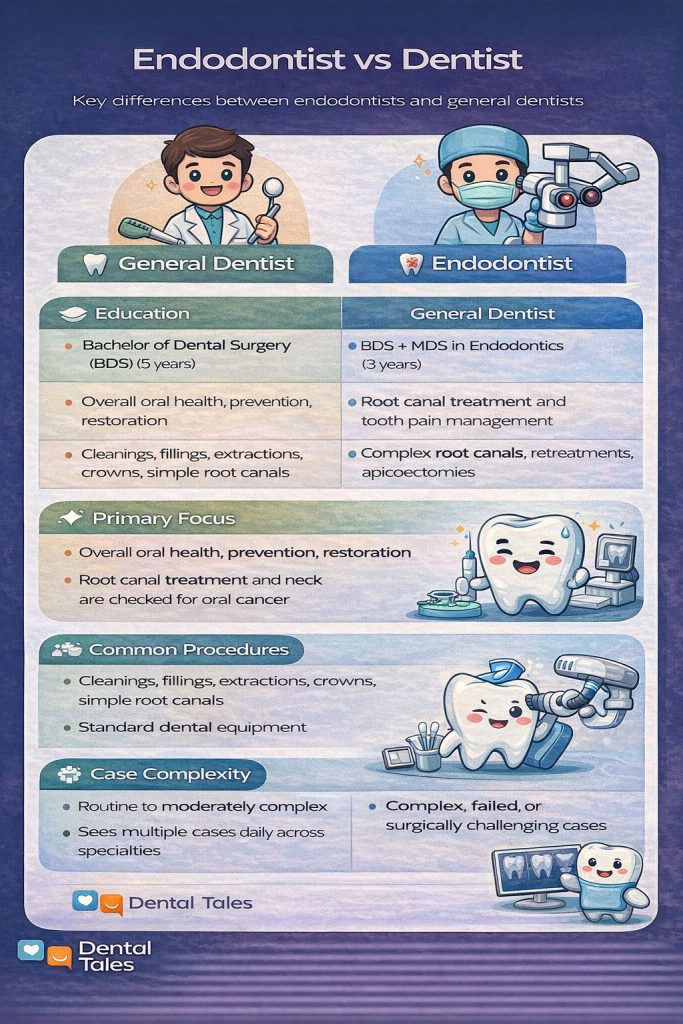
| Aspect | General Dentist | Endodontist |
| Education | Bachelor of Dental Surgery (BDS) (5 years) | BDS + MDS in Endodontics (3 years) |
| Primary Focus | Overall oral health, prevention, restoration | Root canal treatment and tooth pain management |
| Common Procedures | Cleanings, fillings, extractions, crowns, simple root canals | Complex root canals, retreatments, apicoectomies |
| Tools Used | Standard dental equipment | Dental microscopes, CBCT scans, rotary instruments |
| Case Complexity | Routine to moderately complex | Complex, failed, or surgically challenging cases |
| Patient Volume | Sees multiple cases daily across specialties | Focuses exclusively on endodontic cases |
What Is a General Dentist?
A general dentist is your first point of contact for all dental care. After completing a Bachelor of Dental Surgery (BDS), which takes five years including an internship, dentists are trained to diagnose, treat, and manage overall oral health.
General dentists handle a wide range of procedures: routine cleanings, cavity fillings, tooth extractions, crown placements, gum treatments, and yes, many also perform root canal treatments. They’re trained to spot problems early, prevent disease, and restore teeth to function.
For most dental issues, whether it’s a toothache from a cavity, bleeding gums, or a chipped tooth, your general dentist is fully equipped to help. In many cases, especially for straightforward procedures, you won’t need to go beyond your regular dentist.
What Is an Endodontist?
An endodontist is a dentist who has completed additional years of specialized training focused exclusively on the interior of the tooth, specifically the pulp and the tissues surrounding the root. The term “endodontic” literally means “inside the tooth.”
After finishing BDS, an endodontist pursues a three-year Master of Dental Surgery (MDS) in Endodontics.
Endodontists are called in when a tooth’s nerve is severely infected, when a previous root canal has failed, when the anatomy of the tooth is unusually complex, or when surgical intervention is needed to save the tooth. Their entire practice revolves around one goal: saving teeth that might otherwise be lost.
Education & Training: Dentist vs Endodontist
Both dentists and endodontists start with the same foundation, a five-year BDS program that covers anatomy, pharmacology, surgery, and clinical dentistry. But that’s where the paths diverge.
| Training Stage | General Dentist | Endodontist |
| Undergraduate Degree | BDS (Bachelor of Dental Surgery) – 5 years | BDS (Bachelor of Dental Surgery) – 5 years |
| Postgraduate Specialization | None required | MDS in Endodontics – 3 years |
| Total Years of Education | 5 years | 8 years |
| Clinical Focus During Training | Broad exposure across all dental specialties | Exclusive focus on root canal therapy, pulp biology, and endodontic surgery |
| Key Skills Acquired | General diagnosis, cavity fillings, extractions, crown work, basic root canals | Advanced root canal techniques, microscopic dentistry, navigating calcified/missed canals, apicoectomies |
Clinical Focus: What Each One Treats
General dentists take a holistic approach to oral health, while endodontists are problem-solvers for one specific issue: saving teeth with damaged or infected pulp.
| Aspect | General Dentist | Endodontist |
| Primary Approach | Holistic oral health management | Specialized focus on tooth pulp and root canal system |
| Prevention Focus | Teaching proper brushing/flossing, oral cancer screening, early cavity detection | Preventing tooth loss through endodontic intervention |
| Disease Management | Gum disease, tooth decay, oral infections, bite problems | Pulp infections, root canal failures, periapical abscesses |
| Pain Management | Basic pain relief for routine procedures | Advanced diagnosis and management of complex tooth pain |
| Typical Daily Cases | Cleanings, fillings, extractions, denture fittings, simple root canals, crown preparations | Complex root canals, retreatments, apicoectomies, cracked tooth diagnosis |
| Diagnostic Challenges | Broad range across all oral health conditions | Pinpointing unusual tooth pain, hidden fractures, extra canals |
Tools & Technology Used
Walk into a general dental clinic, and you’ll see the standard setup sufficient for most dental procedures. Step into an endodontist’s office, and you’ll notice a different array of specialized tools.
| Equipment/Technology | General Dentist | Endodontist |
| Imaging | Standard digital or film x-rays (2D) | CBCT scans (3D imaging of tooth and bone structure) |
| Magnification | Loupes (2x-4x) or naked eye | Dental operating microscopes (up to 25x magnification) |
| Instruments for Root Canals | Hand files, basic rotary files | Advanced rotary and reciprocating files, ultrasonic instruments |
| Diagnostic Tools | Visual examination, x-rays, percussion tests | Microscopic examination, electric pulp testing, advanced imaging analysis |
| Irrigation Systems | Manual syringe irrigation | Ultrasonic or sonic activation for deeper cleaning |
| Treatment Chair Setup | Standard dental chair | Ergonomic setup optimized for microscope use |
| Purpose of Technology | Adequate for routine procedures and straightforward cases | Essential for visualizing tiny canals, locating fractures, and achieving higher success rates in complex cases |
| Impact on Outcomes | Effective for standard treatments | Significantly increases success rates, especially in retreatments and complex anatomy |
When Should You See a Dentist vs an Endodontist? (Decision Guide)
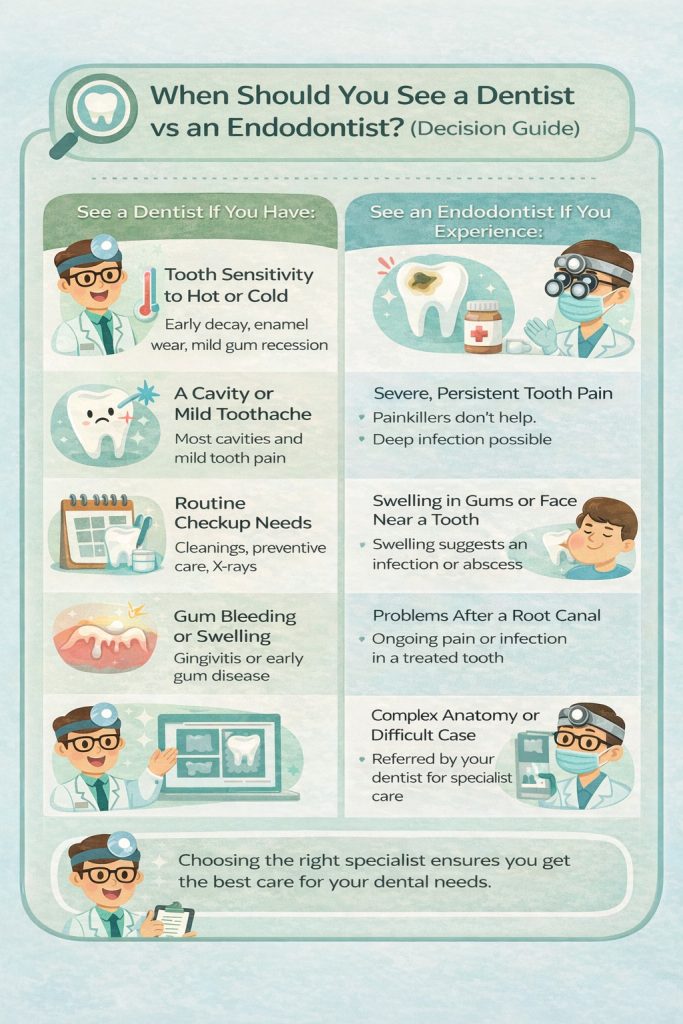
You should go to a general dentist if you have:
- Tooth sensitivity to hot or cold: This often points to early decay, enamel wear, or minor gum recession. These issues can usually be managed with fillings, desensitizing treatments, or preventive care.
- A cavity or mild toothache: Most cavities and early tooth pain can be treated with simple fillings or minor procedures before the tooth nerve is affected.
- Routine checkup needs: Cleanings, preventive care, X-rays, and ongoing oral health maintenance are all handled by your general dentist.
- Gum bleeding or swelling: This commonly indicates gingivitis or early gum disease, which your dentist can diagnose and treat effectively.
You should go to an endodontist if you experience:
- Severe, persistent tooth pain that doesn’t respond to painkillers: This usually signals deep infection or nerve damage that requires specialized treatment, such as a root canal.
- Swelling in the gums or face near a tooth: Swelling suggests an active infection or abscess that needs urgent specialist care to prevent complications.
- A tooth that has already had a root canal but is still causing problems: Ongoing pain or infection after a root canal often requires retreatment, which endodontists are specifically trained to perform.
- Your dentist refers you due to complex anatomy or a difficult case: This referral is about ensuring the best possible outcome using advanced tools and expertise, not a sign of treatment failure.
Related Reads:
Conclusion
Understanding the difference between a dentist and an endodontist doesn’t have to be complicated. Both are essential to your oral health, but they serve different purposes.
Your general dentist is your partner in prevention and routine care, the person who keeps your teeth healthy and catches problems early. An endodontist steps in when a tooth is in serious trouble and needs specialized, focused intervention to be saved.
Remember, the goal isn’t always to see the most specialized provider; it’s to see the right provider at the right time. Trust your dentist’s judgment when they refer you, ask questions when you’re unsure, and prioritize the health of your teeth over short-term cost concerns. A tooth saved today is a smile preserved for years to come.
Frequently Asked Questions (FAQ)
Yes. An endodontist is a dentist who has completed additional specialized training (MDS in Endodontics) after their BDS degree. They focus exclusively on root canal treatments and saving teeth.
Most general dentists are trained to perform root canals and do so successfully for straightforward cases. However, they may refer complex cases, such as retreatments, calcified canals, or molars with unusual anatomy, to endodontists.
Your dentist refers you to an endodontist when your case is complex, when a previous root canal has failed, or when specialized tools and expertise will significantly improve the chances of saving your tooth. It’s a sign of good clinical judgment, not incompetence.
Yes. Endodontists also perform root canal retreatments, apicoectomies (surgical removal of a tooth’s root tip), treatment of cracked teeth, management of dental trauma, and diagnosis of unexplained tooth pain.