“How long do braces take to straighten teeth?”
This is the first question most people ask when they step into an orthodontist’s office. It’s understandable; committing to orthodontic treatment means adjusting your daily routine, your budget, and sometimes your confidence for months or even years.
What most patients don’t realize, though, is that there’s no standard timeline. It depends on your unique dental situation, your age, the type of braces you choose, and how well you follow your orthodontist’s instructions.
This article will walk you through everything that affects how long braces take to work. You’ll learn what actually happens during treatment, why some cases finish faster than others, and what you can realistically expect before you commit.
Key Takeaway: How Much Time Does Bracing Take to Work?
- Braces typically take 6 months to 2.5 years to straighten teeth.
- The exact duration depends on several factors: how severe your misalignment is, whether you have bite problems beyond crooked teeth, your age, and how consistently you follow treatment guidelines.
- Your orthodontist will give you an estimated timeline after your initial consultation, but remember that this is just an estimate.
What Is the Average Time Braces Take?
The typical range for braces treatment is 6 to 30 months, though some complex cases may extend beyond that.
Orthodontic progress is measured in months rather than weeks because tooth movement is a gradual biological process. Your teeth need time to shift through the bone safely without causing damage to roots or surrounding tissue.
Rushing this process can lead to root resorption, gum recession, or teeth that shift back to their original positions.
When orthodontists talk about “average time,” they’re giving you a ballpark estimate based on cases similar to yours.
But every mouth is different. Bone density, root length, gum health, and how your body responds to pressure all play a role in how quickly your teeth move.
Braces Treatment Time by Case Severity
The single biggest factor determining your treatment time is the complexity of your case. Let’s break it down.
| Case Severity | Common Examples | What the Treatment Involves | Expected Duration |
| Mild | Small gaps, slight crowding | Minor tooth movement with simple adjustments | 6–12 months |
| Moderate | Overbite, noticeable crowding | Space creation, tooth alignment, bite adjustment | 12–18 months |
| Severe | Crossbite, jaw misalignment | Complex tooth movement and bite correction | 18–30+ months |
Stages of Braces Treatment (What Happens When)
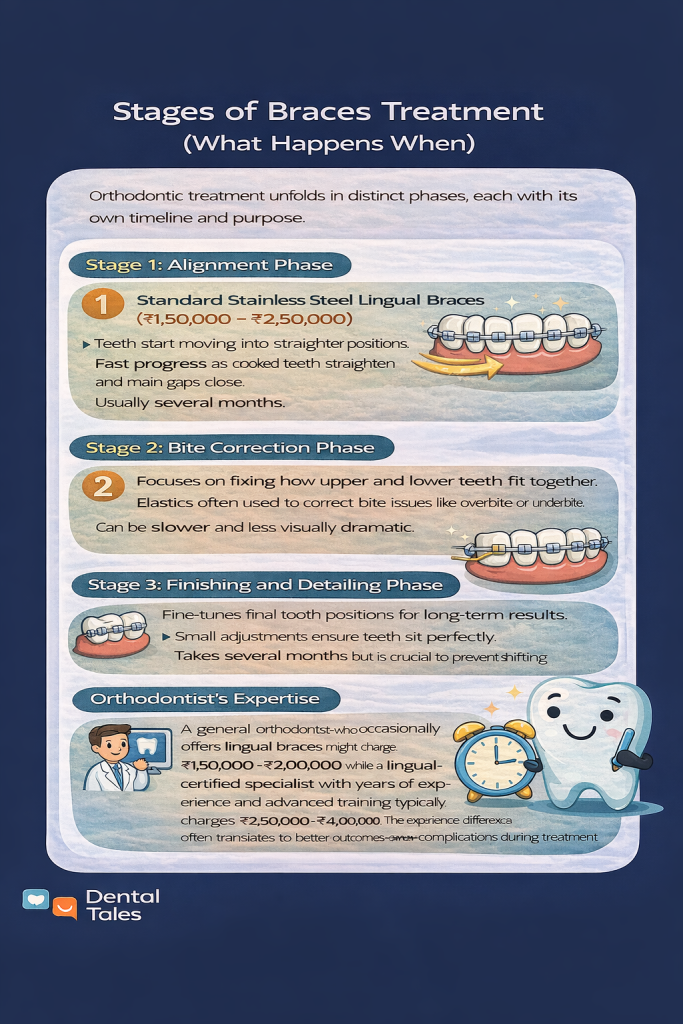
Orthodontic treatment unfolds in distinct phases, each with its own timeline and purpose.
- Stage 1: Alignment Phase
This is when your teeth start moving into straighter positions. You’ll notice visible progress quickly, crooked teeth begin to straighten, and major gaps start closing. This phase typically shows the fastest improvements, which is encouraging for most patients. It usually lasts several months.
- Stage 2: Bite Correction Phase
Once your teeth are straighter, the orthodontist focuses on fixing how your upper and lower teeth fit together. This is when elastics (rubber bands) often come into play.
You might be asked to wear them between specific teeth to correct an overbite, underbite, or crossbite. This phase can be slower and less visually dramatic, but it’s essential for functional, long-term results.
- Stage 3: Finishing and Detailing Phase
In the final months, your orthodontist fine-tunes everything. Small adjustments ensure each tooth sits in its ideal position.
This phase may feel slow since the changes are subtle, but it’s critical for stability. Skipping or rushing this stage increases the chance that your teeth will shift after braces come off.
Factors That Affect How Long Braces Take
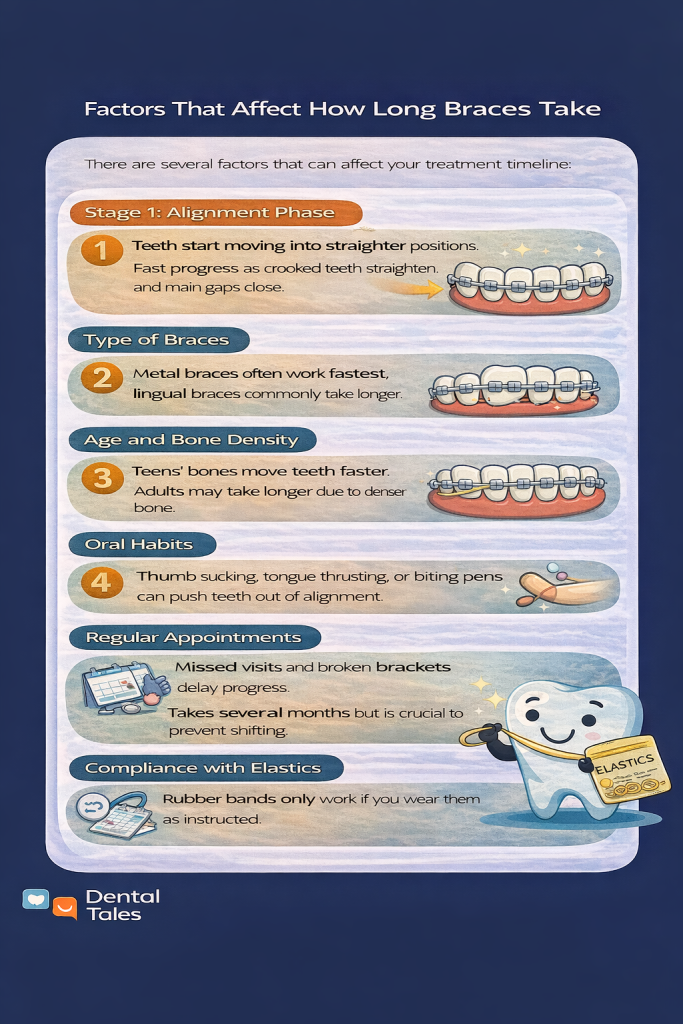
There are several factors that can affect your treatment timeline:
- Severity of misalignment is the most obvious factor. The more your teeth need to move, the longer it takes.
- Type of braces also matters. Traditional metal braces are often the most efficient for complex cases. Ceramic braces work similarly but may take slightly longer due to higher friction. Lingual braces (placed behind the teeth) can extend treatment time because they’re harder to adjust.
- Bone density and age affect how quickly teeth move. Younger patients, especially teenagers, tend to see faster results because their bones are still developing and more responsive to pressure. Adults have denser bone, which can slow movement, though results are still highly effective.
- Oral habits like thumb sucking or tongue thrusting can interfere with progress. If these habits continue during treatment, they can push teeth out of alignment even as braces try to correct them.
- Missed appointments or broken brackets delay progress. Every time you skip an adjustment or break a bracket, treatment stalls. Your orthodontist plans each visit to move you closer to the finish line—missing one sets you back.
- Consistency with elastics and instructions is crucial. If you’re supposed to wear rubber bands 22 hours a day but only wear them at night, you’re essentially pausing your treatment. Compliance is one of the biggest factors within your control.
Do Braces Work Faster in Teens or Adults?
Teenagers often finish orthodontic treatment faster than adults, but the difference isn’t always dramatic.
Teens have the advantage of still-growing bones. Their jawbones are more adaptable, which allows teeth to shift more easily. Orthodontists can also take advantage of growth spurts to guide jaw development, which can reduce overall treatment time.
Adults have denser bones and fully developed jaws. This means teeth move more slowly and may require more force. Adults are also more likely to have gum disease or prior dental work, which can complicate treatment.
However, adults often have better compliance. They’re more likely to follow instructions, attend every appointment, and wear their elastics as directed. This can offset some of the biological disadvantages and lead to predictable, successful outcomes.
The bottom line: age affects the process, but it doesn’t determine success. Adults can achieve the same excellent results as teens; it just might take a few extra months.
Braces vs Aligners: Which Takes Less Time?
| Factor | Braces | Clear Aligners |
| Predictability | Fixed to the teeth, so pressure is continuous and treatment stays on track | Results depend on wearing them 20–22 hours a day |
| Case complexity | Handles severe crowding, bite problems, and difficult tooth movement well | Best suited for mild to moderate alignment issues |
| Effect of missed wear | Teeth continue to move even if elastics aren’t worn perfectly | Skipping wear time can slow progress significantly |
| Typical treatment time | Usually takes 12–24 months with fewer delays | Often estimated at 6–18 months, assuming ideal compliance |
| Overall speed | Often faster for complex cases | Not always faster, especially in difficult cases |
For complex cases, braces are often faster because they can apply a more precise, constant force. Aligners aren’t the “quick fix” they’re sometimes advertised to be, they’re simply a different tool with different strengths and limitations.
Why Two People With Braces Finish at Different Times?
You and a friend might start braces on the same day with similar-looking teeth, but one of you might finish six months ahead of the other. Here’s why:
- Individual bone response varies. Some people’s bones remodel quickly in response to orthodontic pressure; others take longer. This is largely genetic and unpredictable.
- Elastic compliance differs. If one person wears their rubber bands religiously and the other forgets half the time, their timelines will diverge.
- Oral hygiene impacts progress. Poor hygiene can lead to gum inflammation or cavities, which may pause treatment until the issues are resolved.
- Appointment consistency matters. Regularly missed appointments add weeks or months to treatment.
- Hidden complexity exists. Two smiles might look similar on the surface, but one person might have bite issues or root positions that require significantly more work.
Conclusion: Setting Realistic Expectations With Braces
Patience is essential for safe, effective orthodontic treatment. Your teeth are moving through bone, a living tissue that needs time to remodel properly. Rushing this process risks long-term damage.
Treatment time varies from person to person, and that’s completely normal. What matters most is that your orthodontist has a clear plan and that you’re committed to following it.
Understanding what happens during each phase of treatment helps reduce anxiety and keeps you motivated. You’ll have setbacks, a broken bracket, a missed appointment but these are minor bumps in a journey toward a healthier, more confident smile.
Remember: braces are a long-term investment in your oral health, not a quick cosmetic fix. The time you spend in treatment now can prevent decades of dental problems down the road.
FAQs About Braces Treatment Duration
Most people notice visible changes within the first 2 to 3 months. Teeth start straightening, and gaps begin closing. However, bite corrections and final detailing take much longer.
Technically, yes, but it’s not recommended. Removing braces before treatment is complete can leave you with an unstable bite, and your teeth are likely to shift back toward their original positions.
Poor compliance with elastics, missed appointments, broken brackets, and poor oral hygiene are the most common culprits. Severe bite problems and dense bone structure also extend timelines.
Yes. For moderate to severe cases, 18 to 24 months is a common and completely normal treatment duration.
You’ll wear retainers full-time for several months after braces come off, then transition to nighttime wear. Most orthodontists recommend wearing retainers indefinitely, at least a few nights per week, to prevent shifting. Retainers are a lifelong commitment to maintaining your results.